

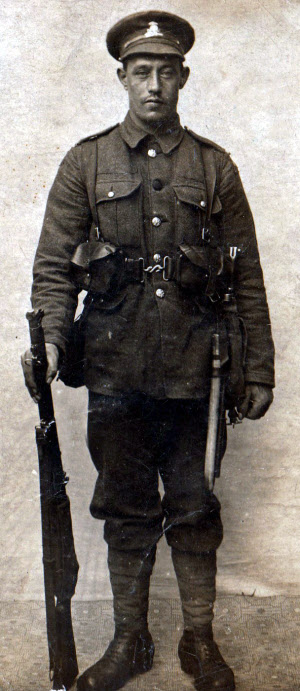
 Private William Coe, 27722, 9th Battalion, Lancashire Fusiliers,
William Coe was born in Ossett in winter 1888, the son of William Coe and his wife Margaret (née Tolson) who married in December 1887. In 1881, William Coe, a plumber and glazier, was living at Little Town End, Ossett with a lodger, Margaret Tolson and her two children. Both William and Margaret described themselves as unmarried.
Margaret Tolson was born in Ossett in 1854. The first census that she appears in was taken when Margaret was seven years old and it recorded her at Little Town-end with her widowed grandmother, Sarah Tolson. Also recorded as living there were Sarah and Amos Chappell. Sarah was the daughter of the older widowed Sarah Tolson and had married Nathan Chappell in 1853. They had only a few short years together as he died in 1857 and in 1860 she married his brother, Amos.
In October 1872, in Ossett, 17-year-old Margaret Tolson gave birth to a daughter called Mary. Margaret's next daughter, Florence, was born on the 21st June 1877, and when she was baptised two days later, no name was recorded for the baby's father. Margaret gave her address as 'Dewsbury Poorhouse of Ossett'. Although Ossett once had a workhouse at Flushdyke, it closed circa 1853. Florence was probably born at Dewsbury Union Workhouse on Healds Road. A third daughter, Ada, was born in 1879.
In the winter of 1885, Margaret gave birth to her fourth child and she named her Sarah Tolson Coe, yet 37-year-old Margaret didn't marry 44-year-old Halifax born plumber William Coe until the 5th of December 1887 when she was expecting her fifth baby. There was no name recorded in the marriage registry for Margaret's father. William died just four months after he and Margaret said their vows at Holy Trinity Church, Ossett. Margaret gave birth to her last child in late 1888 and she named him William Coe, after the father he never met. William Coe was buried at South Ossett Church on the 12th April 1888.
William Coe senior had been born in Southowram, Halifax in 1843 and had spent some time serving in the British Army as Private 1024 in the 47th (Lancashire) Foot Regiment. He was court martialed at Fullwood Barracks, Preston on the 28th June 1873 and sentenced to 112 days imprisonment at Wakefield Prison from the 3rd July 1873 for breaking out of the barracks and for being drunk. He was also discharged from the Army and probably settled in Ossett after he had completed his sentence at Wakefield. His occupation was given as plumber and glazier and at the time of his imprisonment he was 29 years of age.
In 1891, Margaret was recorded at South Street, with her children: Florence, Ada, Sarah and William. The girls were all in school, and Margaret was still working as a rag picker. Three of Margaret’s children, Florence, Ada and Sarah, had all taken the surname of their deceased stepfather William Coe. Her oldest daughter, Mary had left home and was living in Leeds with Sarah Chappell (née Tolson) and her family where she was recorded as her niece.
William’s mother, Margaret had lost her husband William Coe in April 1888 at the early age of 45 years and things were to take a turn for the worse for her, when on the 19th August 1895, she was found guilty of "unlawfully neglecting her children in a manner likely to cause them suffering and injury to health" and sentenced to two months hard labour in His Majesty’s Prison, Wakefield. She was 45 years of age, 5’ 0½” tall, with brown hair and a Methodist. She had no previous convictions and was discharged on the 12th October 1895. William was aged 8 years old in 1895 and had lived in Ossett since his birth.
The "Ossett Observer" had this report:
"STOPPED HER RELIEF FOR GOING TO THE THEATRE - At Ossett Borough Court, on Monday, Margaret Coe, widow, was charged with unlawfully neglecting her three children in a manner likely to cause them suffering and injury to health.
William Smith, an officer of the S.P.C.C., said that on Saturday, the 10th, he visited the house occupied the defendant at Ossett Green, in company with a police-officer. He found three children: Ada aged 15; Sarah aged 9; and William aged 7. All the children were in a filthy state, and some of their clothing had been burned. There was not a lot of furniture in the house. In the cellar was a lot of filth, giving off a dreadful stench, and in the bedroom were two rotten and filthy mattresses, covered with vermin. The floor had the appearance of not having been cleaned for some time, and the defendant told him that she and the children had been sleeping downstairs on the bare floor. He said she had no means of subsistence, but would not go to the workhouse, and her outdoor relief had been stopped because she went to the theatre. He cautioned her nearly twelve months ago.
The Bench committed the defendant to prison for two months without hard labour."
In March 1897 Margaret was in trouble again. The owner of the house she rented wanted her to leave but she wouldn't, so she was summoned to Ossett Borough Court to explain why an ejectment warrant shouldn't be served on her. Whatever she said in her defence, the Bench (comprising Mayor Joseph Cox, A. Mitchell, Oliver Briggs, J.H. Fawcett and J.T. Marsden) found her explanation unsatisfactory and ordered the warrant to be issued.
Margaret Coe née Tolson died in 1898 at the age of 44 years and in 1901, William was 14 years old, and now living as the adopted son of Cookridge farmer Frank Thompson and his wife Matilda. In the same year, his youngest sister Sarah was 15 years old and living at the Certified Industrial School for Girls in Burmantofts, Leeds. Ada Coe was a servant in the home of George Wright Gibbs in Headingley, Leeds.
On the 26th December 1908, at the Parish Church, Birstall, teamer Willie Coe married 22-year-old Jane Ellins. In 1911, Willie Coe, was living at 68, Bradford Road, Gomersal with his wife, Jane and their daughter Edith, who was born on the 3rd October 1909. The family moved to Kippax and William became a miner at Ledston Luck Colliery. The couple had another daughter, Ada, but she died in April 1917, aged just four years. Another child had died prior to 1911.
Private William Coe's army service record has not survived, but it is known that he enlisted at Castleford and joined the Kings Own Yorkshire Light Infantry with service number 23755. At some stage he was transferred to the 9th Battalion, Lancashire Fusiliers with service number 27722. William was killed in action on the 16th August 1917 and was posthumously awarded the British and Victory medals and also the 1914/15 Star, which he qualified for when he embarked for Egypt on the 3rd December 1915.
In the 1914 picture (above) of Private William Coe in his Lancashire Fusiliers uniform, the second button on his tunic is coloured black. During WW1, it was permissible in the British army to wear a small square of black crepe wrapped around the second button of the tunic as a sign of personal mourning. Officers wore black crepe armbands. Photographs of the period sometimes illustrate this practise, and it inspired W.A Darlington's novel "Alf's Button". It was published in 1920, filmed the same year, a stage play in 1924, and re-filmed in 1930 as one of the first British 'talkies'. In 1938, the Crazy Gang made a follow up, "Alf's Button Afloat".
The 9th (Service) Battalion of the Lancashire Fusiliers was formed in Bury, Lancashire on the 31st August 1914 as part of the First New Army (K1) and then moved to Belton Park, Grantham to join the 34th Brigade of the 11th (Northern) Division. In April 1915, they moved to Witley, then Godalming in Surrey. In July 1915, the battalion mobilised for war and embarked for Egypt from Devonport. On the 17th July 1915 they arrived in Alexandria and then moved to Imbros. On the 6th August 1915 they landed at Sulva Bay, Gallipoli and the Division engaged in various actions including the Battle of Scimitar Hill and attack on Hill 60. On the 18th December 1915 they evacuated to Mudros due to the severe casualties from combat, disease and harsh weather and in January 1916 moved to Egypt, arriving at Alexandria on the 31st January 1916 where the Division was involved in the defence of the Suez canal.
In July 1916, they moved to France, landing at Marseilles and the Division engaged in various actions on the Western Front including the capture of the Wundt-Werk (Wonder Work) in 1916, plus the Battle of Flers-Courcelette and the Battle of Thiepval during 1917.
Private William Coe died aged 29 years on the 16th August 1917 during the Battle of the Langemarck part of the Third Battle of Ypres. The attack was from Steenbeck stream with objectives a line about half a mile NE of the Zonnebeke/Langemarck Road and a location known as White House.
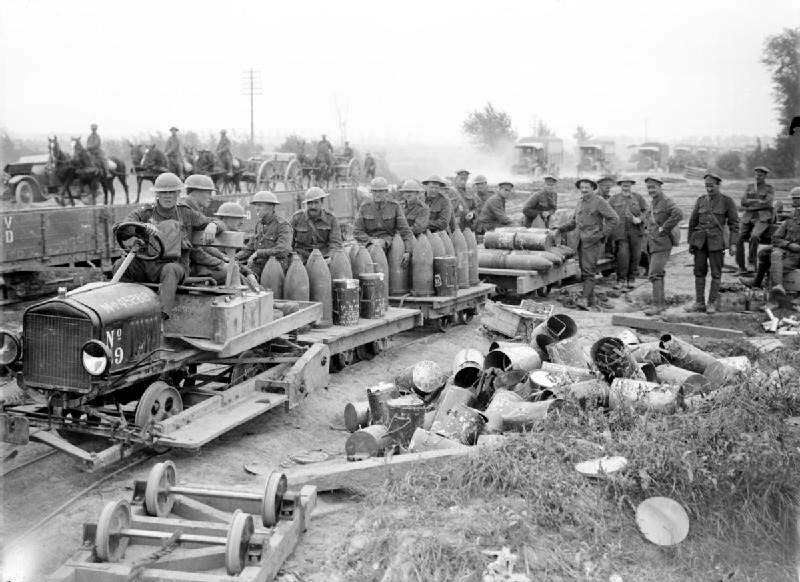
Above: Light rail ammunition transport during the Battle of Langemarck in August 1917.
Private William Coe is remembered on Panels 54 to 60 and 163A of the Tyne Cot Memorial,1 Zonnebeke, West-Vlaanderen, Belgium. The Tyne Cot Memorial to the Missing forms the north-eastern boundary of Tyne Cot Cemetery, which is located 9 kilometres north east of Ieper town centre, on the Tynecotstraat, a road leading from the Zonnebeekseweg (N332). The names of those from United Kingdom units are inscribed on Panels arranged by Regiment under their respective Ranks.
The Tyne Cot Memorial is one of four memorials to the missing in Belgian Flanders which cover the area known as the Ypres Salient. Broadly speaking, the Salient stretched from Langemarck in the north to the northern edge in Ploegsteert Wood in the south, but it varied in area and shape throughout the war.
The Salient was formed during the First Battle of Ypres in October and November 1914, when a small British Expeditionary Force succeeded in securing the town before the onset of winter, pushing the German forces back to the Passchendaele Ridge. The Second Battle of Ypres began in April 1915 when the Germans released poison gas into the Allied lines north of Ypres. This was the first time gas had been used by either side and the violence of the attack forced an Allied withdrawal and a shortening of the line of defence.
There was little more significant activity on this front until 1917, when in the Third Battle of Ypres an offensive was mounted by Commonwealth forces to divert German attention from a weakened French front further south. The initial attempt in June to dislodge the Germans from the Messines Ridge was a complete success, but the main assault north-eastward, which began at the end of July, quickly became a dogged struggle against determined opposition and the rapidly deteriorating weather. The campaign finally came to a close in November with the capture of Passchendaele.
The German offensive of March 1918 met with some initial success, but was eventually checked and repulsed in a combined effort by the Allies in September. The battles of the Ypres Salient claimed many lives on both sides and it quickly became clear that the commemoration of members of the Commonwealth forces with no known grave would have to be divided between several different sites.
The site of the Menin Gate was chosen because of the hundreds of thousands of men who passed through it on their way to the battlefields. It commemorates those of all Commonwealth nations, except New Zealand, who died in the Salient, in the case of United Kingdom casualties before 16 August 1917 (with some exceptions). Those United Kingdom and New Zealand servicemen who died after that date are named on the memorial at Tyne Cot, a site which marks the furthest point reached by Commonwealth forces in Belgium until nearly the end of the war. Other New Zealand casualties are commemorated on memorials at Buttes New British Cemetery and Messines Ridge British Cemetery.
The Tyne Cot Memorial now bears the names of almost 35,000 officers and men whose graves are not known. The memorial, designed by Sir Herbert Baker with sculpture by Joseph Armitage and F.V. Blundstone, was unveiled by Sir Gilbert Dyett on 20 June 1927.
Originally, Private William Coe was not remembered on any Ossett Memorial or Roll of Honour, which is likely to be because he left Ossett when he was adopted after the death of his widowed mother in 1898. In 2018 William Coe's name was added to the Ossett War Memorial.
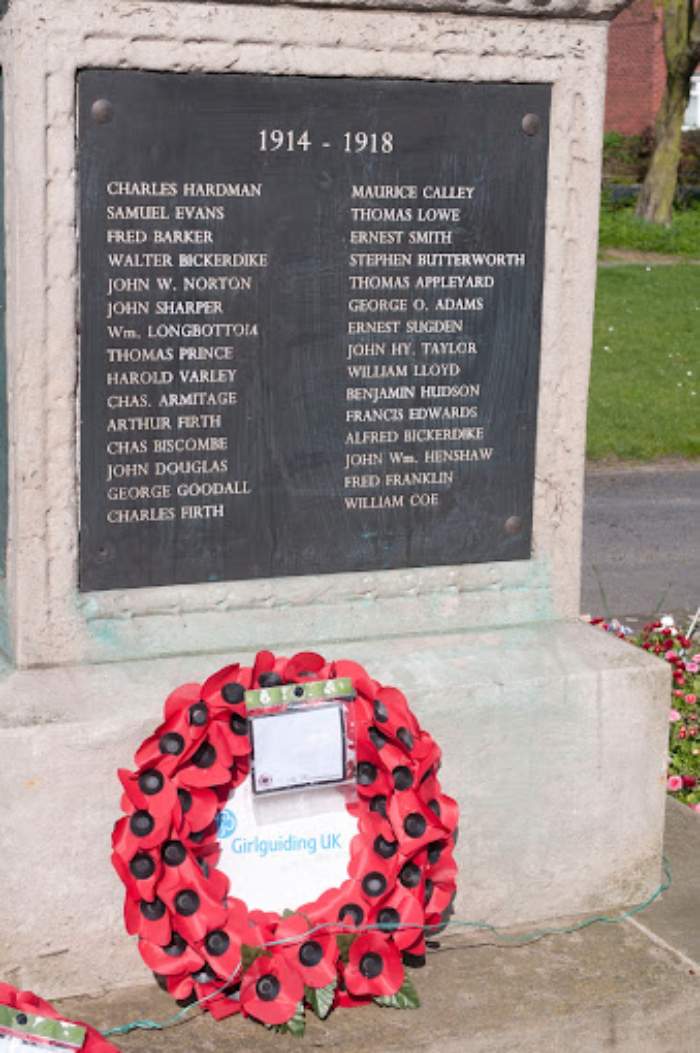
Above: Private William Coe is remembered on the Kippax and Ledston War Memorial along with 60 other men who gave their lives in WW1. Photograph by Paul Harness 2014.
On the 25th June 1919, William Coe's 33-year-old widow Jane Coe married 25 year old Arthur Kilburn in Ledston, near Castleford and their son Arthur was born on December 31st of the same year.
My thanks to Anne-Marie Fawcett courtesy of Ossett Through The Ages Facebook Group for her detailed research on the Tolson and Coe families featured in this updated and corrected biography.
References: