

 Second-Lieutenant Eli Townend Archer, King's Own Yorkshire Light Infantry, 1st/4th Battalion
Eli Townend Archer was born in 1893 and the eldest son of Ossett councillor and pork butcher David Hanson Archer of Runtlings Grange, Ossett. Archer's mother Emma was the daughter of Eli Townend, a well-known and respected Ossett mill owner. Archer was educated at Ossett Grammar School and Silcoates School in Wakefield. He was gazetted at the Officer Training Corps at Leeds University before joining the army proper. A keen cricketer for Dewsbury and Savile Town, he was unmarried.
The 1st/4th Battalion of KOYLI was formed in August 1914 at Wakefield and was part of the 3rd West Riding Brigade, West Riding Division. They moved on mobilisation to Doncaster and then in November 1914 to Gainsborough. The battalion moved again to York in February 1915 for training and on the 12th April 1915, they landed at Boulogne. On the 15th May 1915 the formation became 148th Brigade, 49th (West Riding) Division.
After being out in France for several months, Second-Lieutenant Archer was one of four young officers who went out with a bombing party during the Battle of the Somme on the 23rd July 1916, but went missing.
The other missing officers were Second-Lieutenant Allen J. Mountain, whose father, Mr. T.H. Mountain was a bank manager in Wakefield; Second-Lieutenant J. Plews, son of the late clerk to the Wakefield city justices; and Second-Lieutenant James C. Jubb of Batley.
A letter from Archer's servant was subsequently received by his family, which stated that he had left the officer, who had been wounded, in a shell-hole out in "No Man's Land." A search party was sent out to find Lieutenant Archer, but failed to find him. A strong German patrol had been seen in the vicinity and it was hoped that they had taken Archer as a PoW, but sadly his body was never recovered. 1
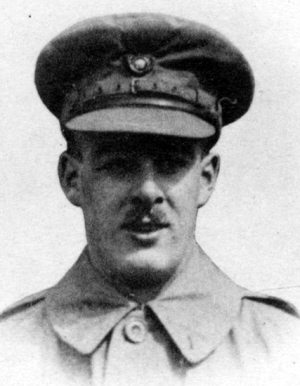 The following is an account of the action in the second phase of the Battle of the Somme, which took place on the 23rd July 1916, and where 2nd Lieutenant Eli T. Archer of 1/4 KOYLI lost his life (shown right at the time he went missing). It is the same action that Ossett man Private Frederick W. Richardson also lost his life: 2
"Sir Douglas Haigh, Commander-in-Chief of the British Armies in France, ordered the second great concentrated effort to be entered upon by the Fourth Army in the morning of the 14th July 1916 along the line from the Leipzig salient in the north to the point of junction with the French forces in the south. The high ground of the ridge to the east of the Bazentin villages and to the south-east of them, was the objective; the hold on the Leipzig salient was to be extended and Thiepval was to be threatened, but this northern end of the ridge was too strongly fortified to be carried by direct attack for the present.
The 4th and 5th Battalions of KOYLI had undergone re-organisation while in huts at Martinsart Woods and they returned to the trenches on the 21st July 1916. On the 23rd July at 2:30 a.m. part of the 4/KOYLI was ordered to attack with a view to extending the position in the salient. Heavy casualties were suffered when crossing No Man's Land and the enemy were found to be in force in their lines; the attackers were too much weakened to put up a fight and were forced to withdraw, having Lt. J.C. Plews wounded and 2/Lts. A.J. Mountain, E.T. Archer and J.C. Jubb killed. The enemy bombers counter-attacked up the trenches leading to our lines, but were beaten back by the 4th Bn bombers, assisted by those of 5/KOYLI and of the 4th and 5th Bns Y & L. In addition to the officers mentioned there were 66 casualties in other ranks, of whom 6 were killed. Lt.-Col. H.J. Haslegrave was wounded the following day."
It is most likely that 2nd-Lieutenant Archer died in the Battle of Pozieres Ridge, a subsidiary attack of the Somme Offensive, and launched on 23rd July 1916. The Battle of Pozieres Ridge on the Albert-Bapaume road saw the Australians and British fight hard for an area that comprised a first-rate observation post over the surrounding countryside, as well as the additional benefit of offering an alternative approach to the rear of the Thiepval defences.
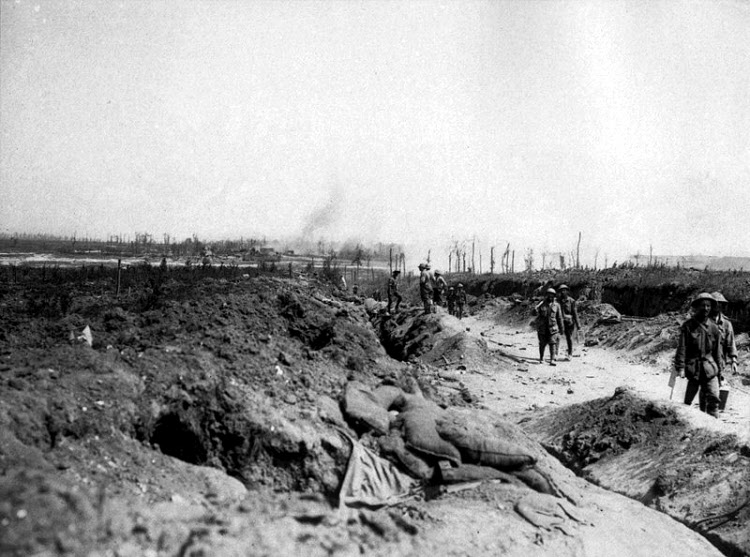
Above: The road to Pozières, 1 August 1916. The view is north towards the village of Contalmaison, which is being shelled by the Germans.
2nd-Lieutenant Eli Townend Archer died on the 23rd July 1916 at the age of 23 years and is remembered on Pier and Face 11 C and 12 A of the Thiepval Memorial,3 Somme, France. The Thiepval Memorial will be found on the D73, next to the village of Thiepval, off the main Bapaume to Albert road (D929).
The Thiepval Memorial to the Missing of the Somme, bears the names of more than 72,000 officers and men of the United Kingdom and South African forces who died in the Somme sector before 20 March 1918 and have no known grave. Over 90% of those commemorated died between July and November 1916. The memorial also serves as an Anglo-French Battle Memorial in recognition of the joint nature of the 1916 offensive and a small cemetery containing equal numbers of Commonwealth and French graves lies at the foot of the memorial.

Above: The Archer grave at St. John's Methodist Chapel showing the memorial to Eli Townend Archer, the son of David Hanson Archer and grandson of Eli Townend. Picture courtesy of Lisa Jennings.
References:
1. "Ossett Observer", 5th August 1916
2. "History of the KOYLI", written in 1929 by Lt.-Col. R.C. Bond, Commanding Officer of the 2nd/KOYLI during WW1
3. Commonwealth War Graves Commission web site
ELI TOWNEND ARCHER - by Dr Andrew Wilson, Sydney, Australia
A detailed biography of the life and death of Ossett's Eli Townend Archer. The author Dr Andrew Wilson is a medal collector and historian from Sydney, Australia who specialises in the biographical research of medals. Andrew owns the war medals awarded to Eli Townend Archer for his WW1 service.
Eli Townend Archer was a patriotic and measured young man who lost his life at the age of 23 in service of his country. Being one of only two commissioned officers from the Yorkshire town of Ossett to die in the First World War, Eli's death had a significant impact on the society he left behind.
Eli was born on the 16th March 1893 at Calder Villa, Healey Rd in Ossett, the son of David Hanson Archer and Emma Townend. Eli came from a line of prominent men of the town of Ossett in West Yorkshire. Ossett appears in the 1806 Domesday Book as Osleset and was possibly the place of King Osbhert's death fighting the Vikings on 21 March 867. In the 19th Century, Ossett was prominent for the milling and weaving of plain, woollen cloth known as kersey. The Healey Low Mill situated on the banks of the River Calder was built between 1815 and 1830 along with the Healey New Mill, using steam powered machinery to full and mill cloth. These mills were established as co-operative enterprises between the cloth families in the area, who felt that with the new technology of the Industrial Revolution, their town's efficiency and productivity could be improved. Eli's maternal grandfather Eli Townend, after which he would be named, rose from the depths of poverty to purchase the Healey Low Mill and propel his name into the annals of Ossett's history in the late 19th Century.
 Eli Townend Sr (shown left as painted by Mark Senior. Source: The Hepworth Wakefield) founded a small company with John William Smith producing mungo and shoddy cloth, regional fabrics made from recycled yarn. Born in 1846 and remaining illiterate throughout his life, Eli Sr sold pies, fabricated rags, and logged trees to raise enough money to found this company. The Wakefield Express published an expansive obituary for Eli after his death on 23 July 1910:
"MR ELI TOWNEND died at his residence, Calder Villa, on Saturday morning at the age of 64 years. For several years past Mr. Townend had been ailing, and latterly he had been confined to the house. By his death Ossett – and one might almost say the West Riding- has lost one of its most remarkable characters. Though plainly garbed, rough in appearance and manner, expressing himself in homely West Riding dialect, and so illiterate as scarcely to be able to more than sign his name, yet Mr. Townend had a wonderful knowledge of men and things, and his words on public bodies always carried weight.
Under his rough exterior Mr. Townend had a very generous heart, and many were his benefactions. His grandfather and father were both Ossettonians, and he himself was born here, the eldest of a family of nine. He never had any schooling, and when only about eight years of age he was taken to work amongst the rags at Messrs. C and R Phillips. Afterwards he was a logger on another mill.
He married early. He added to his scanty earnings by selling hot pies in the streets in the evenings, and by dint of hard working and saving, he was able, with a partner some 40 years ago, to start a very small business in the rag and mungo line at the Green. After a time they removed to Healey Low Mill. When the partnership was dissolved Mr. Townend kept on business at Healey Low Mill. His shrewdness and great business ability built up a large undertaking, which came to be named Eli Townend Ltd. In Mr. Townend's earlier days, when the rag sorting and mungo trades were but young, profits were more easily made than is the case now. Then, some ten or twelve years ago, his business was among those transferred to a syndicate.
Of late years Mr. Townend took but little part in business. He was a Liberal and a Nonconformist. As indicated above, he was a liberal giver, and was always ready to support philanthropic institutions, and his private charities were numerous especially at the Christmas season, with gifts of coals and blankets. During the south African war he was a generous helper of such dependants of Volunteers and others at the front who were in need.
Mr. Townend was a member of the Local Board, and has been a member of the County Council for a time, also the Dewsbury Board of Guardians. In 1890, at the incorporation of the town, he was elected on the Town Council as a representative of. The West Ward. In 1893 he gave way to his brother, Mr. Walter Townend, who was elected unopposed. In 1903 he was again elected for the West Ward and was re-elected in 1907, and his term would have expired next November.
Mr. Townend was twice married, and by his first wife he had a family, of whom one son and three daughters are living. The funeral took place on Tuesday afternoon, the interment being at the South Ossett Wesleyan Burial Ground. The funeral was said to have been the largest seen at Ossett. The Town Hall flag was half-mast as were the flags at the various clubs and along the route closed blinds was a general thing. The Town Hall bell was tolled from 1.45 to 3 o'clock. The funeral procession which left the house at 2 o'clock included the Mayor Mr Bentley, and all the members of the Council, with the exception of Cr. Wootton, the Town Clerk, Mr. T.W. Wilson, and the Town's officials, the magistrates, representatives from various institutions, a large number of townspeople, and numerous friends from various parts of the West Riding, more especially Dewsbury, Batley, Horbury, Wakefield, and other neighbouring places. There were thirty-eight carriages, and two of these were filled with wreaths and flowers, including one from the Corporation and officials. The route was lined with spectators. There was a service at the South Ossett Wesleyan Chapel, conducted by the Rev. C.S. Reader."
It was into this aspirational climate that Eli Jr was born. His father, a councillor, and both his grandfather and great uncle Walter, sat on various community board during his childhood. In 1900, his sister Mary was born and by the 1901 Census, the family were living at 9 School Street, Ossett. Eli's father was still working as a butcher at this time and the family were wealthy enough to employ a maidservant who lived with them. Eli's younger brother Jack Townend Archer was born in 1902, taking a similar patronymic name. It was clear that the young men were intended to follow in the footsteps of their notable ancestors.
With their inheritance, Eli's parents wisely elected to improve their children's social positions through education. Eli attended Ossett Grammar School for his elementary schooling. Founded in 1735, Ossett Grammar School was initially a free school providing broader education to those in Ossett who were unable to afford private education, such as workers of the cloth and agricultural industries. The school was closely associated with the Chapel of Ease which drew the ire of some Ossett townsfolk who felt that education should take a more secular approach. Nonetheless, the trustees were mostly of religious extraction and the repair and upkeep of the school was inextricably linked to funding from the Church of England.
With Ossett's expanding population, the school reformed its curriculum to focus on matriculation to university. By the time that Eli attended Ossett Grammar School, likely from 1899, French was taught, and Latin could be learned at an extra fee. With Ossett itself reclassified as a borough of Wakefield, it required a town hall. The site of Ossett Grammar School was therefore demolished to make way for this new building in July 1906, at which time it is likely that Eli relocated to Silcoates School approximately 5 kilometres away.
The Silcoates School was founded in 1820 as the Northern Congregational School at Silcoates House for the education of the sons of Nonconformist clergymen. Silcoates School was a boarding school and Eli attended until his graduation to Leeds University.

Above: Eli Archer in a group photograph of the Ossett 'Teddies' Temperance Society Football Team 1910-1911.
Eli led a varied life as a young man. He played cricket for Dewsbury and Savile Town, being mentioned several times in local newspapers recording scores from weekend matches. He played football for Ossett Temperance Football Club, an offshoot of the Ossett Temperance Institute which Eli and several of his family were members of. Eli is pictured in a group photograph of the 1910-1911 season in centre of the middle row. Sadly, two other men in this photograph were killed during the Great War including George Gawthorpe standing second from the right in the back row of the image above and Archer Townend, Eli's maternal first cousin sitting on the middle row on the extreme left.
During his university years, Eli joined the Leeds University Contingent Senior Division Officer Training Corps (OTC) of Leeds University. With the world sliding towards conflict, Eli may have been cognisant of the emerging necessity of military training. He was promoted to Second Lieutenant in the OTC on 15 June 1915 and commissioned as a Second Lieutenant into the 1/4th Battalion King's Own Yorkshire Light Infantry (KOYLI) on 2 July 1915.
By the 1911 Census, Eli is listed as living with his family at 10 Runting Grange in Ossett. Jack, Mary, David and Emma lived together with both of the men providing for the family. Eli had followed his maternal ancestors' professions as a rag merchant. By 1915, Eli had moved out to rent in Dearden Street nearby still in Runting Grange.
 At this time, the Great War had broken out whilst Eli and the 1/4th KOYLI were on their annual summer training exercise. It is likely that he was second-in-command of D Company, which drew its recruits from Ossett. The unit utilised The Drill Hall in Ossett on the corner of Station Road and Fairfield Terrace. Although Eli was registered to vote in Ossett, his unit was moved to Doncaster in August 1914; Gainsborough in November 1914 and York in February 1915. The excitement would have been palpable amongst the men.
After all, Eli had more patriotism than most. In 1901, his father, grandfather and great uncle had all been instrumental in raising volunteers to serve with the 1st KOYLI in the Second Anglo-Boer War. The Townend and Archer families gave speeches at both the sending off and returning parades for G Company, 1st KOYLI at the local train station. This must have had a profound effect on Eli, possibly even motivating him to take up arms with his OTC in the first place.
On 25 May 1916, Eli's Medal Card Index indicates his entry into France via Boulogne. At the time, the War Diary lists the 1/4th KOYLI as billeted at Talmas northeast of Amiens. The battalion moved to Bois D'Aveluy to furnish working parties for the 32nd Division on 22 June 1916. During this period of time, the 1/4th KOYLI were undergoing a nervous period of training before moving to trenches near Aveluy Wood. Eli was trained as one of the battalion bombers, employed to use grenades in both offensive and defensive manoeuvres. It is likely that his pre-war athleticism including his cricketing, stood him in good stead for this role. He was placed in 'X' Company in charge of a platoon and it was during this period that he became familiar with his men in their billets. On 30 June 1916, the battalion moved into trenches outside Aveluy Wood and Northumberland Avenue.
The offensive of 1 July 1916 at Thiepval involved a a disastrous set of piecemeal attacks at great cost. The 1/4th KOYLI were being worked up to join the attack, but were recalled on 1 July 1916, sparing them the horrendous casualties of the battalions ahead of them. Nonetheless, the War Diary mentions that the battalion heard the thunderous days of continuous drumfire leading up to the assault as Eli's first sounds of conflict.
Eli and the 1/4th KOYLI moved to Thiepval Wood on 2 July 1916, taking over the stretch of the front line. They were almost immediately gassed with lachrymatory shells and shrapnel causing light casualties. A more concerted gas attack was thought to be making its way from the German lines in the morning of 3 July 1916 and Eli stood at arms with his men. Thankfully again, this turned out not to be the case.
On 4 July 1916, the German front line renewed its efforts at an aggressive defence, opening an intense bombardment on the 1/4th KOYLI followed by rapid rifle fire. This was particularly directed towards parties carrying wounded and dead soldiers back to the British lines. Operating with the 5th KOYLI, W Company of the 1/4th KOYLI attacked the German front line but were forced to withdraw in the face of heavy opposition. The day was spent by consolidating existing positions. It rained continuously during these operations and the War Diary notes that the trenches were waterlogged on both sides.
The 148th Brigade War Diary for 4 July 1916 summarised the movements:
"The night had been fairly quiet. A sharp burst of German rifle fire was explained by Col. Rendall as caused by enemy seeing our parties collecting wounded in 'No Man's Land'…'D' Coy entering by A.18, preceded by bombing squads to mvoe towards A.10 and 20 and consolidate strong points at A.19…All communication trenches leading into this area to be blocked and guarded by bombers. In addition to bombs already stored in 'A' trenches 900 bombs would be taken forward by the relieving Coys and before daylight a further supply carried up to A.18. As already mentioned, this relief was complete by 4 pm… At 7.30 a party of Germans in steel helmets was seen going from B.19 along Comm. Trench towards A.17 – perhaps to relieve a bombing post. At 8.20 the enemy started registering on our new communications trenches and the SUNKEN Road, evidently intending to prevent further work there later. At 10 am he opened a very sharp bombardment with lachrymatory sells on the new communications trenches and right down THIEPVAL Wood. The trench, especially where it crosses the Sunken Road, was much knocked about, the enemy's identity wishing to make the completion of a good trench impossible. There was also some shelling of the crossings of the ANCRE below the Wood. At times during the day the enemy shelled his old line where held by us.
5th KOYLI report their bombing squads at A.17 engaged with bombing squads of the enemy all morning, and maintained the superiority…Heavy rain fell in the early afternoon, under cover of which the enemy began a counter and gained a footing in our positions in 'A' line. Two platoons of 'Z' Coy, 4th KOYLI were…moved up from THIEPVAL WOOD and 'W' Company 4th KOYLI was ordered to counter-attack under Capt. Muirhead, being led to its objective by 2/Lt Wilson, 4th Y&L. The enemy had, however, been repulsed though heavy shelling and some sniping and bombing were proceeding."
The 1/4th KOYLI War Diary wrote of the day:
"9 am Germans bombarded our front line and the Marsh.
2 pm Enemy opened rapid rifles fire on our right and commenced intense bombardment on our front. Information was received from 5th KOYLI that the enemy were attacking our position in the 'A' Line under cover of a heavy thunderstorm and that artillery support had been called for…it was decided to send Capt. Barber…and send two platoons of 'Z' Company to take over the position vacated by Capt. Barber. 'W' Company was ordered to counter-attack under Capt. & Adjt. J.I. Muirhead, this party being directed to their objective by 2/Lt. Wilson…On arrival at the 'A' line the 5th KOYLI were found to be still in possession, the enemy having been driven off. Heavy shelling and some sniping and bombing was proceeded."
Though held in reserve during this action, this was Eli's first taste of combat. With 46 casualties on 4 July 1916 alone, there is no doubt that Eli would have heard the sanguine cries of the wounded amongst the chatter of small arms fire and the thudding of artillery shells finding their mark. Given that the British had occupied many of the existing German front line trenches in their series of harrying raids, it did not take long for the German marksmen and artillery to dial in the range on their sights. It was to much relief that the 5th KOYLI were found to have stood their ground in the old German line, as the 1/4th KOYLI would have been sent to relieve them in force, likely with more casualties.
The next day, 5 July 1916, Eli himself entered the fray in support of an attack made by the 5th KOYLI. Seeking to broaden the Thiepval front, the 5th KOYLI were ordered to take the German front line to the west towards the Ancre River and stretch the front line towards Martinsart Wood.
The 148th Brigade War Diary detailed this attack with mixed success:
"As mentioned above, 2 platoons of 4th KOYLI supported the successful bombing attack of 5th KOYLI at 4am and 'W' Coy under Capt. Plackett with 2 squads of Battalion bombing platoon helped 5th KOYLI to eject the German counter…arrangements were made by 'A' Coy supported by 'D' Coy to seize and consolidate points in 'A' system towards the River Ancre. The first surprise attack at 2 am failed at its inception, the Germans apparently being fully prepared. The second assault was to be delivered at 3.10 am after 10 minutes intense bombardment was postponed till 4.10. The assault was delivered with great resolution but immediately met with heavy barrage, and the leading platoon almost annihilated. The supporting platoons captured A.10 and worked their way about 200 yards towards A.20 before being driven back by the enemy, now reinforced by bombers supporting their snipers. Their bombers appeared to outrange ours. The support given them by their snipers was very effective. Supply of bombs apparently by throwing them forward to their bombers. After a short resistance we lost A.19 and the enemy again pierced our trenches but were driven out with the help of 4th KOYLI bombers.
From the OP at first little could be seen in the bad light but from 8 on much bomb fighting was visible, though confused and difficult to follow. About 9 Major Littledale got a Battery A/153 to fire on enemy parties in A.19, while the enemy shelled A.17. It appeared that the enemy had retired from A.17 but we could not hold it as the communication trench from B.19 held a part of enemy bombers. Targets were indicated from the OP to the artillery with good results. A forward party of 40 Germans was cut off from supply and finally ran back up the communication trench (which was blown at points). Several casualties were observed. The artillery fire was directed to enable our bombers to consolidate A.17. By 11 am our bombers had not appeared on the A.19 side of A.17, and the action seemed over.
At 6.30 am an artillery OP had reported large parties of Germans in their second line, apparently prepared to advance. At 1230 pm from our OP we saw a red flare burnt and black disc waved (the arranged signals) at A.18. The enemy were seen at A.19 and shelled…At 1.25 pm a very encouraging report came of French progress South of SOMME. Total of prisoners taken by British 4,300. During the afternoon there was heavy fire on the Marsh and MESNIL. At 3.30 pm shelling was reported for the first time of AVELUY WOOD – perhaps the enemy got information from prisoners or from some map taken – as they began to shell 'C" trenches.
By 4.30 pm 5th KOYLI relieved by 4th and returned to assembly trenches in THIEPVAL WOOD. Under orders received from the 4th Army, Lieut. Peck, who had reconnoitred on the previous day, and 4 men of 5th KOYLI occupied the DIVION MILL for sniping purposes. The 5th Y&L had 1 Coy in McMahon's Post and 3 in THIEPVAL WOOD assembly trenches. 4th Y&L reported trenches in parts 18" deep in water and mens' feet beginning to give trouble. At night 'A' and 'B' Coys relieved 'C' and 'D' Coys in the front line."
The 1/4th KOYLI War Diary from the day adds further detail:
"4 am 2 platoons of 'Z' Company supported bombing attack made by 5th KOYLI on the enemy's trenches. The attach was unsuccessful. Casualties slight. Enemy attacked position held by 5th KOYLI and gained entrance to front line out were rejected by two squads of the Battalion Bombing platoon and 'W' Company under Capt. H. Plackett. Casualties: 2/Lt. T.H. Riordan and 2/Lt. E.T. Archer wounded; 3 other ranks killed and 20 wounded."
It appears that Eli was wounded during this action as he led his platoon of battalion bombers to the rescue of the beleaguered 5th KOYLI under severe counterattack. One can only imagine the terror and adrenaline that coursed through Eli in equal measure as he brought his bombers up to the firing line. Eli would have been under rifle, machine gun, artillery and mortar fire whilst hurling grenades at the German advance; not to mention the Germans' grenadiers who seemed to outrange the British. Given that Eli's wound did not prevent him from continuing to fight with his battalion, it is probable that he received a shrapnel wound possibly from an enemy grenade during this action.
The next day, 6 July 1916, the 1/4th KOYLI stood at arms to withstand a counterattack. Again, bombing parties were sent to the advanced saps to bomb the German line under intense enemy grenade attack themselves. Successfully, they advanced the line some 70 yards that day. On 7 July 1916, the German bombing raids intensified as did their artillery.
The War Diary continued:
"Enemy bombers advanced down the trench towards A.18 and A.16 and across the open to A.17 a furious fight with bombs ensued lasting till 6.30 am. Numerous casualties were incurred both from bombs and enemy snipers, who were lying out in the open and who shot down our men as they fired and threw bombs out of the trench. Major H. Moorhouse, DSO in command of the Sector was wounded in the army by a sniper about 4 am, but remained in command till 5.30 am when forced through loss of blood to go to the Dressing Station. Capt. W.M. Williamson, Commanding 'Z' Company, and 2/Lts. Carter, Massie, Mackay, De Jonquet, and Huntington were also wounded. Capt H.G. Fraser took command and continued to fight till 6.30 am when he ran out of bombs and was forced to retire down the communication trench to the original British Front Line which he held along with the 4th and 5th Y&L Regt already there with the 35 men remaining out of the two companies till 9.30 am when he was ordered to return to the assembly trenches in THIEPVAL WOOD. Casualties: other ranks 20 killed, 180 wounded."
Eli would have been receiving medical attention at one of the field hospitals behind the line whilst this battle raged. The 1/4th KOYLI War Diary 8 July 1916 records his return:
"2/Lts Archer and Butler arrived to replace casualties."
On this day, the battalion was relieved by the 5th West Riding Regiment and departed the front-line westwards to Martinsart Wood. The desperation to break the static warfare that constituted July 1916 on the Somme is evident in these few days that the 1/4th KOYLI spent in combat. The battalion had 8 officers and 361 other ranks as casualties during these seven days of fighting. Ad testament to the courage that the 1/4th KOYLI had displayed during this time, a special Division Routine Order (DRO) was issued,
"The Army Commander considered that the defence of the trenches in R.19.c by the 49th Division on 7th July, was will and gallantly conducted and reflects great credit on all concerned."
After several days rest at Martinsart Wood, Eli and 'X' Company moved to Leipzig Salient, reliving the 4th York and Lancaster Regiment in the front line on 22 July 1916. The Liepzig Salient was a moniker for a German defensive position constructed in 1915 opposite the village of Authuille, northeast of their position at Aveluy Wood. On 1 July 1916, just 21 days prior to the 1/4th KOYLI occupying the position, the 1/17th Highland Light Infantry had successfully surprised the Germans in their front line and took both the Salient and Redoubt on the reverse slope to the northeast. Several attempts had taken place to force the Germans further beyond Liepzig Redoubt but had been cut down with significant casualties. The British defenders had defended against several strong counterattacks including a flamethrower and gas attack on 15 July 1916 that resulted in extensive casualties with little strategic gain for either the Germans or the British.
The 1/4th KOYLI had been brought into the front-line for the first day of the Battle of Pozieres. This offensive was to be a combined operation between the British Fourth Army and the French Sixth Army to force the capture of the village of Pozieres in an attempt to follow up the gains made in the area on 1 July 1916. Capturing Pozieres brought the British further towards turning the second line of German trenches. The 1/4th KOYLI were to attack at the Liepzig Salient in order to extend the German line as a diversion for the Australian attack at Pozieres.
The 148th Brigade War detailed the operation:
"Early on the morning of 22nd, 4th Y&L made a bombing attack and found the German trenches heavily manned and could make no progress as most of the trained bombers became casualties. The enemy retaliated with heavy trench mortars. 4th KOYLI relieved and repeated the attack early on the 23rd but were drive out by a strong enemy counter. They returned a further attack but this was repulsed."
This relatively brief appendix scrawled on paper by hand, is supplemented by the 1/4th KOYLI War Diary for which reads:
"22.7.16
11am Battalion relieved 4th Y&L Regt in the front line. W Coy in the crater, X, Y and Z Companies in the front line.
10 pm bombardment opened on our right and spread along the whole front. Received orders to attack at 2.30 am. X Company were ordered to attach the German lines on the East of the Salient with a view to extending the Salient and keeping the enemy occupied.
23.7.16
2.30 am The attack was met by rifle fire and a barrage of shrapnel and attacking party suffered heavy casualties in crossing No-Man's-Land. On arrival at the German lines the enemy were found to be in force and owing to casualties sustained the part was too weak to put up a fight and had to withdraw leaving 2Lts. Plews and Mountain wounded in the enemy's trenches and 2/Lts. Archer and Jubb missing. The enemy bombers counter attacked up trenches leading to our lines but were driven off by our bombers, assisted by bombing squads lent by 5th KOYLI, 4th and 5th Y&L Regt. Casualties: other ranks 6 killed; 60 wounded."
Through the 1/4th KOYLI's actions In July 1916, the gallantry of their bombing parties cannot be overstated. Carrying the No. 5 Mark 1 'Mill's Bomb' these men advanced through saps or behind cover on open ground, to within 15 metres of the enemy to hurl their grenades. Generally considered deadly to all those standing with 10 metres of the blast, the fragments had an effective range of 200 metres in open country. The confines of trench fighting meant that this range was significantly decreased, although the concussion was amplified within the walls of the trenches the grenades detonated in. With a delay of five seconds, bombers would often 'cook' their grenades by holding them in their hands until about to explode, and then throwing them at the enemy to reduce the chances that they were thrown back. This was not without danger as if the thrower was wounded or distracted with the grenade in its hand, he would surely meet death after those five seconds elapsed.
On 23 July 1916, Eli once again advanced to within several yards of the German trenches, this time ducking between shell craters in no-man's-land. He did not have the benefit of a sap extending to the German lines, nor did he have first-hand knowledge of the terrain, having only arrived in his position several hours beforehand.
Eli undertook his mission with four other officers all from West Yorkshire. Second Lieutenant Allen Mountain whose father was a bank manager in Wakefield, Second Lieutenant John Christopher Plews whose father was a clerk to the Wakefield City Justices, and Second Lieutenant James Jubb who lived in Batley. Eli was accompanied by his batman that day, who sent a letter after the action detailing Eli's demise. Eli was wounded in both legs and the party was forced to leave him in a shell hole whilst retreating with the intention of going out when the fire subsided, to retrieve him. A strong German patrol was seen in the vicinity of the shell hole that Eli lay in and it was hoped that he along with Plews were taken prisoner. However, a search party sent out to find Eli was unsuccessful and his body was never recovered.
Lieutenant Colonel Reginald Bond's regimental history titled "The King's Own Yorkshire Light Infantry in The Great War", recounted fighting in July 1916 including Eli's wounding and death:
The 4/K.O.Y.L.I arrived in their assembly trenches in Aveluy Wood at 3 a.m. on the morning of the 1st July. The 49th Div., being in reserve that day, did not participate in the first great advance, but at 6 p.m. orders were received which placed the 4th and 5th Bns. K.O.Y.L.I at the disposal of the 96th Inf. Bde., in their attack on Thiepval. By 8.15 next morning they were holding trenches in Thiepval Wood, a position which had been won within the first line of the enemy trenches (known as the A line) on the previous day. There were shelled heavily in this position till 5 a.m., the next morning. During the night 'X' and 'Y' Companies of the 4/K.O.Y.L.I were sent forward to relieve the 5/Y.&L; 'W' and 'Z' Companies remained in support.
On the 4th July there was as bombardment, followed at 2 p.m. by rapid fire; under cover of a thunderstorm the enemy launched an attack on the defenders of A trench line in which the 5/K.O.Y.L.I was chiefly involved; however the defenders remained in possession of the trenches and the attack was driver off; the 4/K.O.Y.L.I had Capt. H.C. Fraser and 45 other ranks wounded. The 5th July was occupied in bombing attacks on both sides; after one of our attacks Capt. C.H. Plackett, who had been leading, was reported missing. 2/Lts. T.H. Riordan and E.T. Archer were wounded; 3 other ranks were killed, 20 wounded. 'W' and 'Z' Companies were employed in carrying bombs and ammunition up to the men in A line.
Sir Douglas Haigh, Commander-in-Chief of the British Armies in France, ordered the second great concentrated effort to be entered upon by the Fourth Army in the morning of the 14th July 1916 along the line from the Leipzig salient in the north to the point of junction with the French forces in the south. The high ground of the ridge to the east of the Bazentin villages and to the south-east of them, was the objective; the hold on the Leipzig salient was to be extended and Thiepval was to be threatened, but this northern end of the ridge was too strongly fortified to be carried by direct attack for the present ... The 4th and 5th Battalions of KOYLI had undergone re-organisation while in huts at Martinsart Woods and they returned to the trenches on the 21st July 1916.
On the 23rd July at 2:30 a.m. part of the 4/KOYLI was ordered to attack with a view to extending the position in the salient. Heavy casualties were suffered when crossing No Man's Land and the enemy were found to be in force in their lines; the attackers were too much weakened to put up a fight and were forced to withdraw, having Lt. J.C. Plews wounded and 2/Lts. A.J. Mountain, E.T. Archer and J.C. Jubb killed. The enemy bombers counter-attacked up the trenches leading to our lines, but were beaten back by the 4th Bn bombers, assisted by those of 5/KOYLI and of the 4th and 5th Bns Y & L. In addition to the officers mentioned there were 66 casualties in other ranks, of whom 6 were killed. Lt.-Col. H.J. Haslegrave was wounded the following day."
The "Yorkshire Post and Leeds Intelligencer", 31 July 1916 published Eli's status as missing in action:
"SEC.-LIEUT ELI TOWNEND ARCHER, aged 23, son of Councillor and Mrs. David H. Archer, of Ossett, who has been missing since 22nd July, with three other officers of the K.O.Y.L.I had not been heard of up to yesterday. He was educated at Silcoates, and trained with the Leeds O.T.C., receiving his commission in June of last year. Prior to joining the Forces, he was in business as a rag merchant at Ossett."
The "Ossett Observer", 5 August 1916 printed a more detailed account mentioning Eli's batman:
"As reported in our last issue, Lieut. Archer and other officers went out with a bombing party and did not return. A letter has been received this week from his servant, in which he states that he left the officer who had been wounded, in a shell-hole in 'No Man's Land'. Information from another source says that a search party was sent out but failed to find him, and it was reported that a strong German patrol had been seen in the vicinity and in all probability they had picked him up."
Again, a later issue of the "Ossett Observer" on 29 September 1916 lamented:
"Lieut. E.T. Archer of Ossett, Missing
Failed to Return from a Bombing Expedition
We regret to state that Second-Lieutenant Eli Townend Archer, of the K.O.Y.L.I., the elder son of Councillor and Mrs. D.H. Archer, has been missing since Saturday. He was one of four young officers who on Saturday went out with a bombing party and failed to return. No news of their fate has yet been received.
The other missing officers are Second-Lieutenant Allen H. Mountain, whose father, Mr. T.H. Mountain, is a bank manager at Wakefield, and one of the secretaries of the Wakefield Paxton Society; Second-Lieutenant J. Plews, son of the late clerk to the Wakefield city justices; and Second-Lieutenant J.C. Jubb, of Batley.
Lieut. Archer trained with the Officers' Training Corps at Leeds University until he got his commission. He has been out in France for several months."
The "Yorkshire Evening Post", 23 March 1917 published further biographical information pertaining to Eli:
"Yorkshire Casualties
Fate of Some Soldiers in the Recent fighting
Second-Lieutenant Eli Townend ARCHER, King's Own Yorkshire Light Infantry, elder son of Mr. And Mrs. D.H. Archer of Runting Grange, Ossett, reported missing on July 23 last year is now presumed to be dead. Educated at Silcoates, he joined the Leeds University Officers' Training Corps, in March, 1915, and received his commission in June of that year. In business he was a rag merchant at Ossett."
The "Yorkshire Evening Post", 24 March 1917 announced Eli's death again:
"Yorkshiremen Who Have Fallen
Losses Notified Today
Second-Lieutenant Eli Townend ARCHER K.O.Y.L.I elder son of Counciller and Mrs. D.H. Archer of Runting Grange, Ossett, who was reported missing on 23rd July 1916, is now presumed to have died on that date. He joined the Leeds Univeersity O.T.C., in March, 1915, and received his commission in June of that year. He was a playing member of the Drewsbury and Savile Cricket Club, and previous to joining the Army was in business as a rag merchant at Ossett. He was in his 24th year."
Eli's actions, whilst not earning him a gallantry medal per se were nonetheless heroic. Still recovering from his wound less than three weeks prior, Eli continued to lead his squad of bombers undaunted, eventually costing him his life. He had no dependents being aged only 23 years old, leaving his estate to his father.
Eli was one of four cousins to serve the British Army during the Great War. His cousins Archer and Gerald Townend were both killed in action. His other cousin Frank Townend, suffered from severe shell-shock and was according to family lore, tied to a tree during heavy shelling in order to remedy his 'moral fibre'. This barbaric treatment evidently had the opposite effect and Frank unfortunately stammered when he spoke henceforth.
Eli is memorialised at St John's Methodist Chapel in a family obelisk, as well as at Silcoates School's chapel. With no known grave, he is remembered at the Thiepval Memorial in France.
For his service in the Great War, Eli was awarded the 1914-15 Star, British War Medal, and Victory Medal. His Memorial Plaque was sent to his father.
Eli's story is characteristic of many men who served in the Great War and whose dedication to the protection of what they felt was right, resulted in them paying the ultimate sacrifice for their country.
Sources:
1. British Newspaper Archive. Wakefield Express, 23 July 1910, p. 5
2. RC Bond. The King's Own Yorkshire Light Infantry in The Great War. 1929,
3. The National Archives. WO95.2806/1
4. The National Archives. WO 374/2057
5. British Newspaper Archive. Yorkshire Post and Leeds Intelligencer, 31 July 1916, p.7
6. RC Bond. The King's Own Yorkshire Light Infantry in the Great War 1914-1918. 2009
7. British Newspaper Archive. Yorkshire Evening Post, 24 March 1917, p.5
8. Ossett Observer, 5 August 1916
9. Ossett Observer, 29 September 1916
10. British Newspaper Archive. Yorkshire Evening Post, 23 March 1917, p. 3,
11. British Newspaper Archive. Yorkshire Evening Post, 24 March 1917, p. 7